Thoughts on Deltacraft Propellers
by Steve Leonard, September 2014
Its true to say that there are hundreds of well researched books on propeller design and I don't intend to reinvent the wheel here but merely to comment on the choice of props we have used on Deltacraft vessels over the past 30 years or so.
No propeller is designed to go backwards! So we look at matching the vessel, the available power, the RPM, the most suitable gearbox reduction and also ..can we use this going astern!
Goin backwards!
So starting from going astern. We found that the standard "Clover leaf" configuration was a dog going astern, cavitation was always evident, rumbling and dragging in air and little stopping power and poor braking. You need that ability sometimes, especially if navigating in tight areas. Dave Porter was a great help in designing a new blade that worked well. Its called an Aquapoid shape.
We tried various manufactures but came back to Dave's shape as the best overall. Now the blade shape looks some-what shaped like an ear, large lobe on the trailing edge, grabs water going astern and brakes well with little cavitation.
Goin forward!
The Developed Area Ratio (DAR) is the ratio of total blade area divided by the propeller disc area, or the DAR is the projected area of the blades expressed as a ratio over the area of a circle that the blades sweep.
We have an 80% DAR, So 80% of a disc is covered by the blade area. The rather large blade area is our way of converting horse-power into efficient motion through a large prop area, revolving slowly, and efficiently, with little loss. Having said that we realise and believe that no prop is more than probably 68% efficient, loss occurs due to the slip of course and also radial loss, (a cowl can assist to minimise this).
The propeller is designed to absorb all of the engines power at full propeller RPM. The propeller is the governor for the engine so you can not over rev the engine if the propeller is correct, the engine will simply run out of power as the propeller absorbs it at full RPM thus governing engine RPM. Too much blade area is bad and the engine may be unable to achieve full RPM. We use a four blade prop as we get our 80% DAR and there is another more interesting reason for using a four blade.
We discovered that as the prop blade passes past the aft keel there is a distinct pulse, so three blades make 6 pulse per revolution, yet a four blade prop only two! Think about how that works!
This gave us a quiet boat, no rumble and efficient running, the right DAR, the right pitch and diameter.
The pitch. If you roll the propeller along the ground it will cover the distance of say 13 inches, if its a 13 inch pitch propeller, or 14 if its a 14 inch pitch propeller, in theory you should be able to travel forward 13 inches with each revolution but not so due to the loss mentioned above.
If you roll the propeller along the ground, for one complete revolution, it will travel side-way the diameter of the propeller and forward the distance of the pitch.
So for our 13 inch by 9 inch propeller, it will move forward 13 inches (the pitch) and 28.3 inches sideways (the diameter).
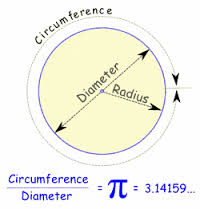 The distance it will travel sideways is 3.1415 times the diameter which in our case is 9 inches multiplied by Pi. You may remember Pi from your school days as per this image.
I always joke and say it only took us 200 boats to get the propeller right!
There is some truth in that, our Naval Architect said for the new Deltacraft Mark 3, released a few years ago, "Well this prop should be about right".
It really is about testing, suffice to say we can move two tonnes of Deltacraft and 10 people with only 9 HP, and a litre of fuel an hour, must be Australia's most frugal fuel user, thanks to a correct Propeller.